


 PLATFORM UPDATE:


CsPbBr3 crystal growth via antisolvent vapor assisted method and their photoelectric properties

Abstract
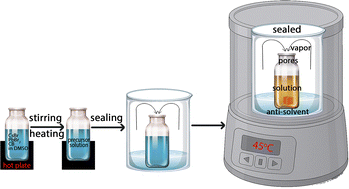
Inorganic halide perovskites, particularly CsPbBr3, have emerged in recent years as promising materials for optoelectronic applications due to their easily tunable bandgap, high charge carrier mobility, and radiation sensing capabilities. This study describes an efficient and straightforward method for growing high-quality CsPbBr3 single crystals using the antisolvent vapor-assisted method, using nitromethane as the antisolvent within a temperature range of 25–45 °C. The resulting crystal has an optical bandgap of about 2.28 eV. X-ray structural analysis confirms the orthorhombic phase. Optical and photoelectrical measurements reveal a clear photocurrent response under UV irradiation at 365 nm, marked by a evident increase in photocurrent density. In addition, the charge carrier mobility–lifetime product extracted from charge collection efficiency analysis reaches ∼0.8 × 10⁻³ cm2 V−1, indicating efficient charge transport. Under visible-light illumination at 530 nm, the crystals demonstrate a responsivity of 6.24 × 10⁻³ A W−1 and a specific detectivity of ∼1.3 × 10¹⁰ Jones. Surface morphology assessed by scanning electron microscopy (SEM) confirms the high surface quality of the crystals. These findings highlight the potential of this modified growth method for producing CsPbBr3 single crystals suitable for next-generation photodetectors and other optoelectronic devices.
 Please wait while we load your content...


