


 PLATFORM UPDATE:


Amplified photocatalytic performance of UiO-66-NH2/BiOI@α-Bi2O3 ternary heterojunctions towards Congo red degradation and H2O2 production

Abstract
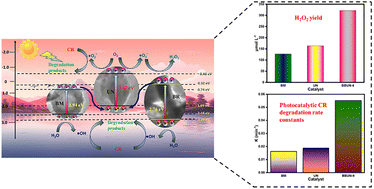
Designing an efficient photocatalytic system that achieves a broad visible-light absorption window and a minimal recombination rate has been challenging. In this work, we have depicted UiO-66-NH2/BiOI@α-Bi2O3 ternary heterostructures’ (BBUN) fabrication via a simple solvothermal approach. FESEM and TEM studies revealed that BBUN-4 consists of UiO-66-NH2 (UN) nanoparticles, BiOI microspheres (BM), and in situ derived α-Bi2O3 nanorods (BR). The morphology of BM and BR was manipulated by varying the BM and N,N-dimethylformamide (DMF) ratio. It was observed that BM microspheres and BR nanorods were obtained when the BM : DMF ratio was maintained at 7.5 : 1. Besides, the interaction of DMF incorporated abundant oxygen vacancies (Ov) in BM and BR. The introduction of abundant oxygen vacancies (Ov) markedly broadened the light absorption edge up to 665 nm. The existence of an Ov–Bi–N interfacial charge transport channel momentously improved the charge transfer and separation rate, as evidenced from PL, EIS, and LSV studies. XPS results, Mott–Schottky analysis, and scavenging tests collectively corroborated the formation of a double Z-scheme BBUN heterojunction. The photocatalytic CR degradation rate for BBUN-4 was determined to be 3.05 and 3.43 times greater than that of pristine UN and BM, respectively. BBUN-4 exhibited H2O2 production of 322 µmol L−1, whereas that obtained over BM and UN was only 127 and 164 µmol L−1, respectively.
 Please wait while we load your content...


