


 PLATFORM UPDATE:


Tramp element drag on grain boundaries controlling microstructural and residual stress equilibration in copper thin-films

Abstract
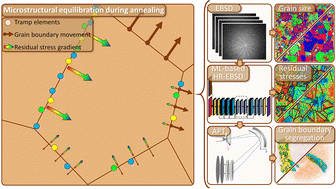
Metallic thin-films are found in a wide range of applications, from energy storage to high-power semiconductors used for green energy technologies. Engineering the growth and treatment of metallic thin-films influences their microstructures and residual stress states, which in turn affect their performance and properties. Here, we uncover the influence of tramp elements on the microstructural equilibration in electroplated Cu thin-films during annealing and evaluate the residual stress states in those Cu thin-films. The residual stress gradients within grains of two Cu thin-films, deposited from different electrolytes, are analysed utilising machine learning (ML) based high-resolution electron backscatter diffraction (HR-EBSD). In order to obtain quantitatively comparable stress mappings for both thin-films, simulated stress-free Kikuchi patterns are chosen as common references for HR-EBSD. Despite vastly different grain sizes after identical annealing treatment, similar stress gradients are present within the grains on both thin-film surfaces. The elemental composition at grain boundaries is analysed with atom probe tomography, revealing that S, Cl and O agglomerate in similar concentrations in the ppm-range at grain boundaries of both thin-films. The methodology corroborates that tramp element drag on grain boundaries during annealing may hinder grain growth from the as-deposited nanocrystalline structure, limiting effective stress relaxation and ultimately triggering failure modes.
 Please wait while we load your content...


