


 PLATFORM UPDATE:


Designing PANI-modified PU films coupled with CNTs for enhanced shape memory properties
 *a
*a
Abstract
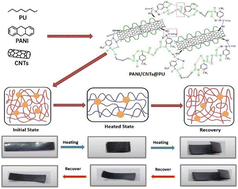
Polyurethane (PU)-based shape memory polymers are considered a supreme choice for shape recovery applications. However, they face problems with their mechanical and thermal properties, which can lead to significant challenges in their development and practical implications. Herein, an effectual and novel strategy has been adopted to overcome these limitations by incorporating CNTs along with polyaniline into the PU chains to form a ternary PU-based nanocomposite. By introducing these conductive fillers, an exceptional elongation at break (18.35%), a higher thermal stability (up to 342 °C), an optimal Young's modulus (456.49 MPa) and high tensile strength (26.49 MPa) were achieved. However, a higher shape recovery aptitude (97%), higher shape fixity (98%) and an enhanced electrical conductivity of 5.00 × 10⁻² S cm−1 were achieved for the ternary hybrid. Overall, the PANI/f-CNTs@PU nanocomposite designed in the current study depicted ideal shape memory parameters, which can be credited to the combined effect of the CNTs and PANI in the PU matrix. The fabricated nanocomposite PANI/f-CNTs@PU can be further utilized in various memory-based applications of materials in diversified industrial applications, including sensors, self-healing materials, electronics, etc.
 Please wait while we load your content...


