


 PLATFORM UPDATE:

Dissolution of pozzolanic materials: a critical review

Abstract
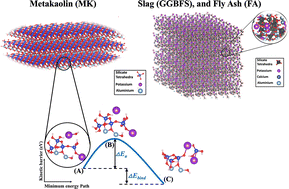
The construction industry is a major source of carbon emissions, driven largely by the production of conventional Portland cement. Reducing this footprint calls for replacing energy- and emission-intensive clinker with supplementary cementitious materials. Pozzolanic sources such as metakaolin (MK), ground granulated blast furnace slag (GGBFS), and fly ash (FA) offer a viable pathway to low-carbon binders when their activation mechanisms are fully optimized. This review synthesizes and integrates recent advances in the activation and valorization of these materials into sustainable aluminosilicate binders. It examines how precursor structure, calcination parameters, activator chemistry, and curing conditions govern dissolution kinetics, gel formation, and resulting microstructure. Experimental findings are complemented by multi-scale computational approaches, density functional theory (DFT), molecular dynamics (MD), and coarse-grained Monte Carlo (CGMC) simulations, providing atomic- to meso-scale insight into reaction pathways and long-term structural evolution. Key results showed that calcination near 700 °C produces highly reactive metakaolin enriched in five-fold coordinated aluminum, NaOH delivers the highest dissolution rates, and sodium silicate fosters denser gel networks, while GGBFS reactivity benefits from Ca- and Mg-driven calcium–silicate–hydrates (C–S–H) formation. Increased structural disorder lowers dissolution energy barriers, enhancing activation efficiency. The integrated experimental–computational framework enables predictive optimization of precursor processing and activator selection, accelerating the development of durable, low-carbon binders from industrial byproducts and supporting the transition toward greener construction materials.
- This article is part of the themed collection: Recent Review Articles
 Please wait while we load your content...


