


 PLATFORM UPDATE:


Unveiling photocatalytic functionalities of (Gd3+, Mo6+) co-doped BiVO4 nanoparticles: an experimental–DFT approach

Abstract
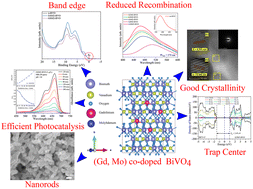
Efficient photocatalysts capable of toxic dye degradation using perennial solar radiation have tremendous potential in environmental remediation. Herein, a surfactant-free hydrothermal process was used to synthesize undoped bismuth vanadate BiVO4 and (Gd3+, Mo6+) co-doped Bi1−xGdxV1−yMoyO4 (x = 0.02, 0.04, 0.06, 0.08, 0.10; y = 0.02) nanoparticles. The presence of mixed monoclinic scheelite (ms) and tetragonal zircon (tz) phases in the as-synthesized nanoparticles due to co-doping was quantified from Rietveld refined X-ray diffraction, Raman, and Fourier transform infrared spectroscopy. Field emission scanning electron microscopy images revealed buck-horn and rod-shaped nanoparticles with an average size of 80–130 nm for undoped and co-doped samples, respectively. The good crystallinity of the (Gd3+, Mo6+) co-doped samples was corroborated by high-resolution transmission electron microscopy. The desired chemical oxidation states of all constituent elements of the co-doped samples were confirmed from X-ray photoelectron spectroscopy. The suitable valence band edge position for driving photocatalytic reactions was observed from ultraviolet photoelectron spectroscopy. The diffuse reflectance measurements implied an increase in the electronic band gap due to co-doping. Hubbard U corrected density functional theory (DFT+U) indicates a shallow trap center in the co-doped samples in favor of reduced electron–hole recombination, which was also supported by photoluminescence intensity reduction. The Bi0.94Gd0.06V0.98Mo0.02O4 photocatalyst degraded 96% of the highly concentrated 50 ppm methylene blue dye over 180 min under simulated sunlight with a reaction rate of 0.01524 min−1. This impressive photocatalytic efficiency can be ascribed to the synergistic effect of the mixed ms–tz phase, small nanoparticle size, good crystallinity, reduced carrier recombination, and proper band edge alignment of the Bi0.94Gd0.06V0.98Mo0.02O4 photocatalyst.
 Please wait while we load your content...


