


 PLATFORM UPDATE:


Protecting white Carrara marble with organophosphorus salts: a case study of ammonium hydrogen phenylphosphonate
 a
M. Carla
Aragoni,
a
Gianfranco
Carcangiu,
b
Simon J.
Coles,
c
Stefano
Columbu,
a
Guido
Ennas,
a
Vito
Lippolis,
a
Paola
Meloni,
*de
Antonia
Navarro Ezquerra,
f
James B.
Orton,
c
Anna
Pintus,
a
Enrico
Podda,
ag
Daniel N.
Rainer,
c
Domingo
Gimeno Torrente
*h
and
Massimiliano
Arca
*a
a
M. Carla
Aragoni,
a
Gianfranco
Carcangiu,
b
Simon J.
Coles,
c
Stefano
Columbu,
a
Guido
Ennas,
a
Vito
Lippolis,
a
Paola
Meloni,
*de
Antonia
Navarro Ezquerra,
f
James B.
Orton,
c
Anna
Pintus,
a
Enrico
Podda,
ag
Daniel N.
Rainer,
c
Domingo
Gimeno Torrente
*h
and
Massimiliano
Arca
*a
Abstract
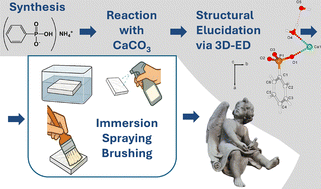
Ammonium hydrogen phenylphosphonate (1) was investigated as a novel agent for the protection and consolidation of carbonate stone substrates. Compound 1 quantitatively reacted with calcium carbonate to give calcium phenylphosphonate dihydrate (2), which was characterized by spectroscopic and microanalytical means and whose structure was solved using 3D electron diffraction. Compound 1 was applied to artificially weathered Statuario white Carrara marble mock-ups through immersion, brushing, and spraying techniques, and its effect on structural, hygric, and mechanical properties was evaluated by means of a comprehensive set of techniques, including X-ray diffraction, ultrasonic velocity measurements, colorimetry, porosimetry, and contact angle measurements. While the application of well-known diammonium hydrogen phosphate (DAP) on carbonate stones results in the deposition of non-stoichiometric hydroxyapatite (HAP), the treatment with compound 1 results in the formation of a thin, homogeneous coating of stoichiometric compound 2 that enhances cohesion, reduces porosity, and improves mechanical resistance, restoring the marble properties to near-pristine conditions. The treatment induces only minimal chromatic changes, making it a promising solution for the conservation of stone cultural heritage.
 Please wait while we load your content...


