


 PLATFORM UPDATE:


Magnetic core–satellite Fe/Cu@Zeolite 13X nanocomposite as an efficient catalyst: performance in indigo carmine and tetracycline degradation
 a
Christian Brice Dantio
Nguela,
a
Georges Teikam
Kenda,
b
Donald Raoul
Tchuifon Tchuifon,
c
Roussin Lontio
Fomekong,
d
Rhaman Abdoul
Ntieche,
ae
Julius Nsami
Ndi,
*a
Horace Manga
Ngomo
*a
and
Cyrille Ghislain
Fotsop
b
a
Christian Brice Dantio
Nguela,
a
Georges Teikam
Kenda,
b
Donald Raoul
Tchuifon Tchuifon,
c
Roussin Lontio
Fomekong,
d
Rhaman Abdoul
Ntieche,
ae
Julius Nsami
Ndi,
*a
Horace Manga
Ngomo
*a
and
Cyrille Ghislain
Fotsop
b
Abstract
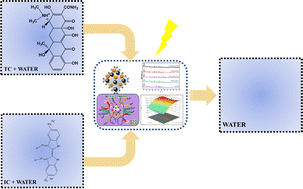
To apply the Fenton process to remove organic pollutants from an aqueous solution, catalysts are needed that can decompose hydrogen peroxide (H2O2) into hydroxyl radicals and regenerate Fe2+ in the system. With this in mind, zeolite-based Fenton-type catalysts were prepared by incorporating Cu2O and Fe3O4 particles into the zeolite X matrix. The core–satellite composite materials (Fe@Zeo13X-1, Fe@Zeo13X-2, Fe/Cu@Zeo13X-1, and Fe/Cu@Zeo13X-2) were synthesized using a hydrothermal-assisted precipitation/co-precipitation method and characterized using X-ray diffraction (XRD), Fourier-transform infrared (FTIR), scanning electron microscopy (SEM), energy dispersive X-ray (EDX) and mapping, electrochemical impedance spectroscopy (EIS), solid UV-visible and N2 adsorption/desorption. The catalytic properties of the synthesized materials on indigo carmine degradation were evaluated. The results revealed that Fe/Cu@Zeo13X-2 exhibits the greatest catalytic activity, achieving a maximum elimination percentage of 99.96% under the following conditions: pH = 2, 0.2 g L−1 of catalyst, 50 mg L−1 pollutant, 5 mL of 0.05 M H2O2, 60 minutes, and daylight. Irradiating the system with UV radiation highlighted the photocatalytic properties of Fe/Cu@Zeo13X-2, justifying its use in optimizing the photo-Fenton degradation of tetracycline using response surface methodology. A maximum elimination percentage of 94.54% was obtained under the conditions (pH = 6; 1 g L−1 of catalyst; 20.92 mg L−1 pollutant; 5 mL of 0.5 M H2O2; 17.2 min). The first-order kinetics model seems appropriate to describe the degradation kinetics of IC by the Fe/Cu@Zeo13X-2 catalyst (R2 > 0.9). The application of the Langmuir–Hinshelwood (LH) model confirms that the degradation process is limited by adsorption. The material showed good stability, allowing it use over several cycles.
 Please wait while we load your content...


