


 PLATFORM UPDATE:


Synergistic potential of MIL-101(Cr) and reduced graphene oxide (rGO) in designing high-performance ammonia sensors
 b
and
Sudhir S.
Arbuj
*b
b
and
Sudhir S.
Arbuj
*b
Abstract
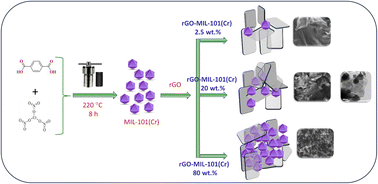
The confluence of metal–organic frameworks (MOFs) and conductive materials has revolutionized gas sensing technology. This study presents a synergistic composite of MIL-101(Cr) and reduced graphene oxide (rGO) for enhanced ammonia gas sensing. rGO–MIL-101(Cr) composites with varying weight percentages of MIL-101(Cr) were synthesized and further characterised using various techniques. By harnessing the exceptional surface area and tailored pore structure of MIL-101(Cr) in tandem with the superior conductivity of rGO, the composite exhibits remarkable sensitivity and fast response times. Among the prepared compositions, rGO–20 wt% MIL-101 (Cr) has demonstrated exceptional sensitivity towards ammonia detection, with a sensitivity of −18.87 for 60 000 ppm and −5.24% for 2000 ppm of ammonia gas and a discernible response at concentrations as low as 1 ppm. Notably, the composite's response remained remarkably consistent and stable, even after one year. This outstanding durability and stability underscore the composite's potential for reliable and long-term ammonia sensing applications. At this percentage, the highest sensitivity is due to the perfect coordination bonding between ammonia molecules and the chromium nodes in MIL-101(Cr), modulating its electrical properties. The formation of a perfect interface between MIL-101 (Cr) and rGO facilitates efficient charge transport, thereby enabling precise detection of ammonia gas. The FE-SEM and TEM analyses clearly show the presence of such an interface. Notwithstanding the comparable or superior sensing capabilities of existing ammonia sensors under optimal conditions, their practical utility is frequently compromised by the susceptibility of the constituent materials to humidity. In contrast, our rGO–MIL-101(Cr) composite exhibits a unique synergy of outstanding sensing performance and notable stability under moist conditions due to its remarkably high surface area and durable architecture. This exclusive combination of properties enables our material to surpass the performance of existing sensors in real-world settings, where moisture is a common factor, and thus offers a significant advantage over existing sensors. This research highlights the potential of MOF-based composites for advanced gas sensing applications, paving the way for further exploration and development of novel sensing platforms.
 Please wait while we load your content...


