


 PLATFORM UPDATE:


Morphology-engineered α-MoO3 nanostructures via MoS2 transformation for high-performance supercapacitors

Abstract
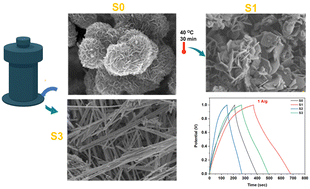
We report a morphology-engineering strategy to enhance supercapacitor performance by transforming hydrothermally synthesized 1T/2H-MoS2 nanosheets into α-MoO3 nanoflakes through controlled thermal annealing. For comparison, α-MoO3 nanoplates and nanofibers were also prepared via calcination and hydrothermal methods, respectively. Comprehensive structural, morphological, and surface analyses confirmed the formation of phase-pure orthorhombic α-MoO3 with distinct morphologies. Electrochemical evaluation revealed that the nanoflake morphology exhibited the highest specific capacitance of 755 F g−1 at a scan rate of 5 mV s−1, along with the lowest charge-transfer resistance of 0.14 Ω at a current density of 1 A g−1 in 1 M H2SO4, outperforming both the nanoplate and nanofiber counterparts. The superior performance is attributed to the high electrochemically active surface area, abundant accessible redox sites, and efficient ion diffusion pathways provided by the nanoflakes. This work demonstrates a simple, scalable route for producing high-performance α-MoO3 electrodes, offering valuable insights into morphology–property relationships for next-generation energy storage devices.
 Please wait while we load your content...


