


 PLATFORM UPDATE:


Optical studies of stimuli-responsive organic crystals differing in the position and nature of functional groups
 *a
*a
Abstract
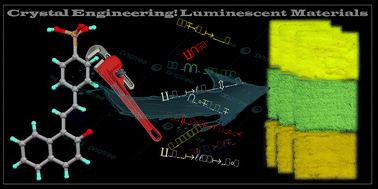
Stimuli-responsive organic materials with dynamically configurable luminescence represent a transformative class of materials with far-reaching implications for next-generation sensing, secure data encryption, and high-performance display technologies. The scope of optical tuning and the ability to precisely modulate emission properties in response to external stimuli offer opportunities for the development of cutting-edge materials that enable breakthroughs in real-time detection, adaptation, and intelligent photonic devices. Focusing on the rational design of luminescent solids, we report three Schiff bases obtained by condensation of hydroxy naphthaldehyde with para-arsenate aniline [1, λmax 558 nm], ortho-arsenate aniline [2, λmax 525 nm], and ortho-sulfonate aniline [3, λmax 535 nm], differing in the position and nature of arsenate and sulfonate functional groups. Anticipated variation of optical properties in the new solid forms is triggered by variation in intra- and intermolecular factors. Structural studies reveal that solid-state emission arises due to the absence of any significant face-to-face π-stacking interactions, while emission tuning is realised through molecular electronic effects generated by functional groups. Multi-stimuli responsive studies carried out for 1–3 indicate the occurrence of crystallization-induced enhanced emission (CIEE) as the emission intensities decline in amorphous grounded forms, the observation further supported by thin film studies. Molecular solids 1 and 3 also exhibit reversible thermofluorochromism, arising due to breathing of lattice water in 3 and phase changes in non-solvated crystals of 1. A non-emissive methanolic solution of 2 exhibits highly selective sensing for Zn(II) ions with an LOD value of 4.9 × 10⁻⁶ M.
 Please wait while we load your content...


