


 PLATFORM UPDATE:

Enhanced gamma-ray shielding performance of Mn and Si-substituted AlPO-41 zeolite frameworks: a pathway to lightweight high-density protective materials

Abstract
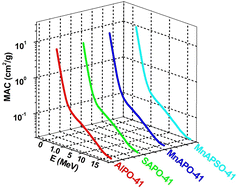
The development of lightweight, efficient gamma-ray shielding materials is crucial for applications in nuclear energy, medicine and aerospace. This work introduces a novel materials design strategy by leveraging the atomic-scale tunability of microporous zeolite frameworks for radiation shielding, a significant departure from conventional composite-based approaches. We systematically investigate the shielding properties of the AlPO-41 zeolite framework and its derivatives—SAPO-41, MnAPO-41, and MnAPSO-41—through elemental substitution. Substituting Si and Mn into the framework increased its density from 3.855 g cm−3 (SAPO-41) to 3.897 g cm−3 (MnAPO-41) and significantly enhanced the effective atomic number (Zeff), with MnAPO-41 reaching a maximum Zeff value of 14.96 at 15 keV. The mass attenuation coefficient (MAC) was calculated over an energy range of 0.015–15 MeV. MnAPO-41 consistently demonstrated superior performance, with MAC values ranging from 9.064 cm2 g−1 at 15 keV to 0.029 cm2 g−1 at 5 MeV. A strong positive correlation between material density and linear attenuation coefficient was established, revealing a performance threshold for frameworks with densities >3.89 g cm−3. These findings demonstrate that strategic Mn and Si substitution in zeolite frameworks is a highly effective strategy for designing high-performance, lightweight gamma-ray shielding materials.
 Please wait while we load your content...


