


 PLATFORM UPDATE:


A comparative study of medium-entropy oxide and metal oxide nanoparticles on graphene oxide for benzyl alcohol oxidation under solvent-free conditions

Abstract
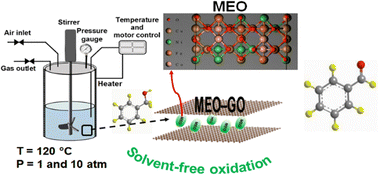
A series of monometallic catalysts, such as Fe3O4, CoO, NiO, and CuO, along with their entropy-stabilized nanoparticles [(Fe,Co,Ni,Cu)3O4 medium-entropy oxide (MEO)], were synthesized and subsequently utilized for the solvent-free and selective aerobic oxidation of benzyl alcohol when supported on graphene oxide (GO). The resulting nanocomposites underwent characterization through various techniques including X-ray diffraction (XRD), scanning electron microscopy (SEM), atomic force microscopy (AFM), transmission electron microscopy (TEM), Brunauer–Emmett–Teller (BET) analysis, thermogravimetric analysis (TGA), Raman spectroscopy, and X-ray photoelectron spectroscopy (XPS), which collectively confirmed the successful formation of monometallic and spinel (Fe,Co,Ni,Cu)3O4 MEO nanoparticles integrated into GO. Among the utilized catalysts, the (Fe,Co,Ni,Cu)3O4 MEO–GO nanoparticles exhibit remarkable catalytic efficiency. A conversion rate of up to 17.2% and 28.8%, along with selectivity rates of 71.4% and 65.7% for benzaldehyde, can be attained in just 5 h at air pressures of 1 and 10 atm, respectively. A comprehensive analytical investigation indicates that the remarkable performance of (Fe,Co,Ni,Cu)3O4 MEO–GO nanocomposites can be ascribed to the synergistic interaction between the active sites of GO and the plentiful oxygen vacancies present in the (Fe,Co,Ni,Cu)3O4 MEO nanoparticles. The exceptional catalytic behavior of (Fe,Co,Ni,Cu)3O4 MEO–GO nanocomposites is attributed, according to detailed analyses, to the synergy between GO active sites and the numerous oxygen vacancies within the MEO nanoparticles. In summary, the extensive experimental findings indicate the promising use of (Fe,Co,Ni,Cu)3O4 MEO–GO nanocomposites within the chemical sector for the targeted oxidation of alcohols into high-value products.
 Please wait while we load your content...


