


 PLATFORM UPDATE:


Enhancing the uniformity of CuBi2O4 thin films for photoelectrochemical (PEC) water splitting through a urea-modified ethylene glycol electrolyte

Abstract
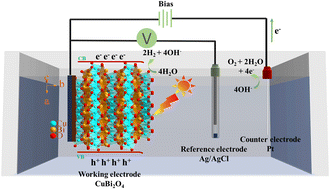
A CuBi2O4 photocathode with interconnected nanoparticle textured morphology has achieved a photocurrent density of −0.94 mA cm−2 at 0.52 V vs. RHE. It was successfully fabricated via electrodeposition using ethylene glycol (EG) containing a specific concentration of Bi(NO3)3·5H2O and CuCl2·2H2O as the electrolyte, followed by 2 h of calcination at 550 °C. Using urea as a complexing agent in the EG electrolyte enhanced the photocurrent density of the CuBi2O4 photocathode. Adding 0.15 g of urea to the electrodeposition solution improved film uniformity, enhanced PEC water splitting efficiency, and achieved a photocurrent density of −1.44 mA cm−2 at 0.52 V vs. RHE. This value is higher than those of previously reported CuBi2O4 photocathodes, which typically exhibit photocurrent densities below −1.0 mA cm−2. To understand the factors contributing to this enhanced PEC performance, this study investigated the effects of varying urea concentrations (0, 0.1, 0.15, and 0.2 g per 100 mL EG) on the crystallite domain size, morphology, surface roughness, light absorption, band gap, electronic band structure, and PEC performance. A mechanism was proposed to account for the long-term stability based on its inadequate valence band potential and irreversible degradation behaviour. This work provides insights for optimizing CuBi2O4 thin films to enhance their stability and efficiency in PEC water splitting applications.
 Please wait while we load your content...


