


 PLATFORM UPDATE:


First-principles investigation of sulfur and sulfur-oxide compounds as potential optically active defects on (6,5) SWCNT
 *a
Sahar
Sharifzadeh
abfg
*a
Sahar
Sharifzadeh
abfg
Abstract
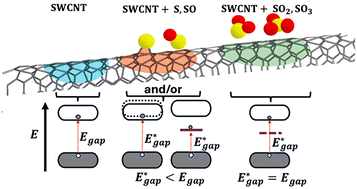
Semiconducting single-walled carbon nanotubes (SWCNT) functionalized with covalent defects are a promising class of optoelectronic materials with strong, tunable photoluminescence and demonstrated single photon emission (SPE). Here, we investigate sulfur-oxide containing compounds as a new class of optically active dopants on (6,5) SWCNT. Experimentally, it has been found that when the SWCNT is exposed to sodium dithionite, the resulting compound displays a red-shifted and bright photoluminescence peak that is characteristic of doping with covalent defects. We perform density functional theory calculations on the possible adsorbed compounds that may be the source of doping (S, SO, SO2 and SO3). We predict that the two smallest molecules strongly bind to the SWCNT with binding energies of ∼1.5–1.8 eV and 0.56 eV for S and SO, respectively, and introduce in-gap electronic states into the bandstructure of the tube consistent with the measured red-shift of (0.1–0.3) eV, consistent with measurements. In contrast, the larger compounds are found to be either unbound or weakly physisorbed with no appreciable impact on the electronic structure of the tube, indicating that they are unlikely to occur. Overall, our study suggests that sulfur-based compounds are promising new dopants for (6,5) SWCNT with tunable electronic properties.
 Please wait while we load your content...


