


 PLATFORM UPDATE:

Metal oxide hybrid materials: on-surface modulation of aggregation-induced fluorescence
 *a
Florian
Daumann,
ab
Phil
Köhler,
c
Frank W.
Heinemann,
d
Gerald
Hörner,
ab
Roland
Marschall
*c
and
Birgit
Weber
*ab
*a
Florian
Daumann,
ab
Phil
Köhler,
c
Frank W.
Heinemann,
d
Gerald
Hörner,
ab
Roland
Marschall
*c
and
Birgit
Weber
*ab
Abstract
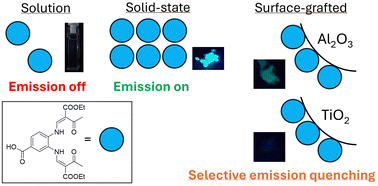
Covalent grafting of molecular compounds to extended oxide surfaces provides variable access to hybrid materials. While in many cases the properties of both components are additive, some favorable combinations can lead to the emergence of new properties. In this work, we report on the aggregation-induced fluorescence of an N2O2 (proto-) ligand H2L1 of the JäGER-type on oxide surfaces. The ligand is non-fluorescent in solution but shows strong greenish-blue fluorescence in the bulk and, importantly, once covalently anchored to oxidic surfaces via an appended carboxylic acid moiety. Intermolecular π−π stacking interactions dominate the packing in single crystals both of H2L1 and a congener with methyl blocked acid function, H2L2. As revealed by electronic spectroscopy, the high surface loadings of H2L1 on Al2O3 and TiO2 allow stacking in a dense surface layer also on the solid supports. While non-fluorescent dilute solutions of H2L2 and H2L1 resonate only in the UV range below 380 nm, the consistent shift of the spectral onset to > 430 nm for bulk ligand and Al2O3-grafted material lends additional support to a supramolecular origin of fluorescence. Sharply reduced (but not vanishing) ligand fluorescence on TiO2 indicates electron-injection to the conduction band to be operative, as further supported by the reduced emission lifetimes recorded via time-correlated single-photon counting. On-surface synthesis of the respective zinc(II) complexes likewise gives strongly fluorescent materials, showing again a reduced emission on TiO2.
- This article is part of the themed collection: Celebrating International Women’s Day 2026: Women in Materials Advances
 Please wait while we load your content...


