


 PLATFORM UPDATE:


Controlled silanization and biomolecular conjugation via ultra-stable carboxyl silatrane for neurofilament light chain detection
 *bd
and
Chun-Jen
Huang
*aef
*bd
and
Chun-Jen
Huang
*aef
Abstract
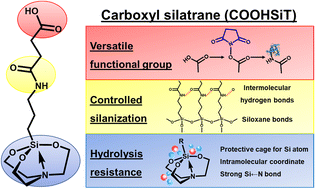
Organofunctional silanes have garnered significant attention in materials science and nanotechnology due to their ease of use, rapid reactivity, and superior performance in adhesion, crosslinking, surface modification, moisture scavenging, and rheological enhancement. However, incorporating carboxyl functionality into alkoxysilanes remains challenging, largely due to their chemical instability arising from acid-catalyzed hydrolysis and intramolecular ring formation via O-acylation. In this work, we introduce an ultra-stable carboxyl silatrane (COOHSiT) engineered for controlled silanization to form thin, uniform, and functional organosilicon layers tailored for biosensor applications. The unique silatrane architecture characterized by a robust tricyclic cage and a stabilizing transannular N→Si dative bond imparts exceptional hydrolytic stability, preserving structural integrity throughout the organic synthesis and long-term storage, as confirmed by nuclear magnetic resonance (NMR) spectroscopy. Surface deposition of COOHSiT on silicon wafers was characterized using ellipsometry, contact angle goniometry, atomic force microscopy (AFM), X-ray photoelectron spectroscopy (XPS) and Fourier transform infrared (FTIR) spectroscopy. The resulting films exhibited excellent uniformity and well-controlled thickness, attributable to the precise silanization and intermolecular hydrogen bonding between amide groups. Importantly, the COOHSiT coatings maintained accessible and reactive carboxyl groups, enabling efficient downstream functionalization via EDC/NHS chemistry for antigen/antibody conjugation. This platform was successfully employed for neurofilament light chain (NfL) detection using a fiber-optic nanogold-linked immunosorbent assay (FONLISA), achieving an impressively low limit of detection (LOD) of 0.56 fM. Altogether, COOHSiT emerges as a highly functional and stable organosilicon building block, opening new avenues for the development of advanced functional nanomaterials and biosensing technologies.
 Please wait while we load your content...


