


 PLATFORM UPDATE:

Nanoarchaeosomes loaded with tumor antigens elicit antigen-presenting cell activation and T cell response for cervical cancer immunotherapy

Abstract
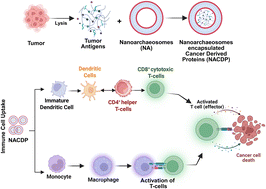
Cancer remains one of the leading causes of mortality worldwide, necessitating the development of innovative therapeutic strategies such as cancer immunotherapy, which harnesses the body's immune system to recognize and eliminate tumor cells. Despite the promise of nanoparticle-based cancer immunotherapy, current platforms often suffer from poor thermal stability and rapid loss of bioactivity, limiting their clinical efficacy. To address these shortcomings, in this study, we developed a protein-based therapeutic nanovaccine targeting cervical cancer by incorporating cervical tumor antigens into nanoarchaeosomes (NACDPs). The formulated NACDPs were characterized using SEM, DLS, and zeta potential analyses, confirming optimal particle size, surface charge, and stability. NACDPs exhibit high thermostability and enhanced protein loading efficiency. When tested on isolated PBMCs, monocytes and dendritic cells showed high internalization efficiency of NACDPs. Moreover, treatment of dendritic cells and macrophages with 500 µg mL−1 of NACDPs led to significant upregulation of MHC II (HLA-DR) and co-stimulatory surface markers (CD86, CD80, and CD83), indicating maturation of antigen-presenting cells (APCs). Fluorescence imaging revealed that NACDP-treated APCs demonstrated high cytoplasmic uptake of DIO-labeled nanoarchaeosomes compared to control formulations. Co-culture of these APCs with T cells (1 : 10 ratio) showed cellular interactions within 30 minutes. This was accompanied by enhanced T cell proliferation, elevated IFN-γ levels, and increased expression of key T cell markers CD4, CD8, and CD20. Notably, T cells primed with NACDPs induced approximately 80% lysis of target cancer cells at a 1 : 10 effector-to-target ratio. Based on the various salient outcomes, it is noted that tumor protein incorporated with nanoarchaeosomes unveils a significant role as a vaccine targeting tumor cells in immunotherapy.
- This article is part of the themed collection: Supramolecular peptide and protein systems
 Please wait while we load your content...


