


 PLATFORM UPDATE:


Shrimp shell-derived chito-protein nanocomposites for sustainable dye effluent remediation: efficiency, reusability, and environmental safety

Abstract
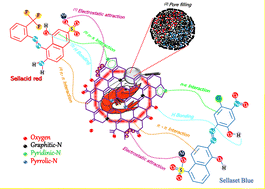
The transformation of seafood processing residues into advanced functional materials offers a dual solution to environmental pollution: mitigating waste streams while addressing water contamination. In this study, shrimp exoskeletons were valorized into a chitin–protein composite (SE-CP) through acid demineralization and thermal activation and evaluated as a biosorbent for the removal of anionic textile dyes Sellacid Red (SR) and Sellaset Blue (SB). The material was characterized using SEM, EDX, FTIR, XRD, BET, DLS, XPS, and PZC analyses, confirming a mesoporous structure (specific surface area = 51.4914 m2 g−1) enriched with amino and hydroxyl groups that favor electrostatic and hydrogen-bonding interactions. Batch adsorption studies showed maximum removal efficiencies of 99.2% for SR at pH = 3 and 98.7% for SB at pH = 4 both around 20 °C and an initial dye concentration of 100 mg L−1. Kinetic data fitted the pseudo-second-order model (R2 > 0.96), and equilibrium was best described by the Freundlich isotherm, with adsorption capacities of 158.43 mg g−1 (SR) and 63.81 mg g−1 (SB). SE-CP retained over 76% of its adsorption capacity after five regeneration cycles, indicating strong stability and reusability. This work demonstrates a low-cost and sustainable biosorbent derived from shrimp waste, with high efficiency, reusability, and green synthesis, positioning SE-CP as a promising candidate for industrial dye wastewater treatment within circular economy principles.
- This article is part of the themed collection: Celebrating International Women’s Day 2026: Women in Materials Advances
 Please wait while we load your content...


