


 PLATFORM UPDATE:


Controlling the phase transition dynamics of GeTe by Sn substitution for phase change memory, photodetection and neuromorphic devices

Abstract
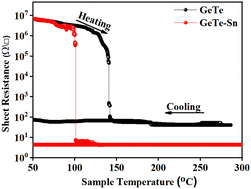
Chalcogenide-based phase change memories are considered for next-generation phase change random access memory (PCRAM) applications because of their unique reversible crystallization and amorphization properties. This study investigates the effects of substituting germanium (Ge) with tin (Sn) in GeTe-based phase-change memory (PCM) materials. Substitution with Sn can play a crucial role because it decreases the electrical bandgap and lowers the phase transition temperature, which benefits tailored low-power PCM and neuromorphic applications. The addition of Sn accelerates the crystallization process to the stable cubic phase, potentially controlling the PCM device's switching speed. Furthermore, optimizing the Ge/Sn ratio is crucial, as excessive Sn may lead to enhanced resistance contrast and reduced data retention, and can be utilized in applications such as multi-bit memory devices. Although both alloys can be used for memory applications due to their distinct phase contrast, the presence of Sn replacing Ge appears to be an ideal choice for photosensor applications as well. The photoresponse study of the prepared samples under dark and light conditions assessed the photodetection ability of the materials. Annealing played a crucial role in enhancing the photodetection performance of the prepared films, leading to a sustainable alternative for photodetection devices using chalcogenide semiconductor materials. These findings contribute to the development of more tunable and reliable PCM materials for future memory and photosensor applications. The potential of bandgap engineering and tuning transition temperature reveals the importance of lowering the impulses for neuromorphic applications.
 Please wait while we load your content...


