


 PLATFORM UPDATE:


Computational assessment of the photovoltaic potential in efficient donor–acceptor non-fullerene molecules

Abstract
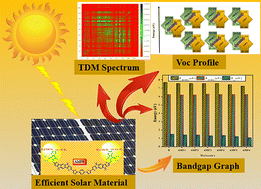
For the advancement of organic solar cell (OSC) technology, it is essential to develop photovoltaic (PV) materials with enhanced conduction band properties, optimized electrochemical behavior, and higher power conversion efficiency (PCE). Quantum chemical modeling is a key component of the design of high-performance organic photovoltaics (OPVs) and optoelectronics. The aim of this work is to determine the most promising materials for OSCs by modeling and characterizing several unique non-fullerene (NF) donor–acceptor complexes (AMF1–AMF6) formed from the R [Ph(T-IDIC)2] phenylene core with two T-IDIC arm molecules. The MPW1PW91/6-31G(d,p) basis set is used in this research to assess the electrical properties, charge transport features, and molecular structures of these compounds using density functional theory (DFT) and time-dependent DFT (TD-DFT). Important analyses include studies of charge transfer, open-circuit voltage (Voc), density of states (DOS), transition density matrix (TDM), molecular electrostatic potential (MEP), and natural bond orbital (NBO). Compared to the reference molecule AMF (R), the results demonstrate a better λmax value of 689.22 nm in the solvent phase (DCM), a lowered band gap (Eg) of 1.015 eV, and a binding energy (Eb) of −0.251 eV. Additionally, in comparison to the reference molecule, the developed molecules exhibit a high open-circuit voltage (Voc) of 1.262 V and a fill factor (FF) of 90.20%. Furthermore, due to the higher exciton dissociation rate, AMF6 exhibits the highest potential for solar energy applications among the studied systems. The results from TDM and MEP analyses show that the tailored AMF6-based non-fullerene molecule outperforms traditional fullerene-based systems, paving the way for more efficient and environmentally friendly organic electronic devices. The results provide insightful guidance for improving the stability, performance, and design of opto-electronics and solar energy conversion devices.
 Please wait while we load your content...


