


 PLATFORM UPDATE:

Single-host white light emission in self-activated Rb3−xCsxY1−yBiyV2O8: crystal engineering for high-performance indoor lighting

Abstract
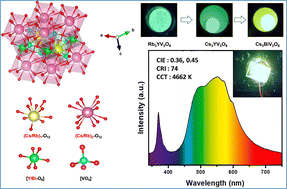
In our quest to replicate the full spectrum of natural daylight, which creates comfortable and visually stimulating reading environments, we have engineered a novel single-component phosphor based on divanadate compounds. Traditional broadband yellow-emitting rare-earth garnet systems often underperform due to insufficient emission in the red and cyan regions, delivering light with noticeable spectral gaps and cooler tones that can strain the eyes during prolonged reading. This tailored approach replaces rubidium with cesium and strategically incorporates bismuth into the Rb3−xCsxYV2O8 matrix, inducing fine crystal field modifications that boost luminescence intensity and generate a warm white emission. The altered light output effectively minimizes the drawbacks of multi-phosphor assemblies, offering a streamlined solution that overcomes issues such as high correlated color temperatures and poor color fidelity. The Cs3Bi0.25Y0.75V2O8 composition exhibits high thermal stability, retaining 75% of its emission intensity at 423 K, with a robust activation energy of 0.32 eV. When integrated into LED devices, the phosphor demonstrates a remarkable ability to shift the white emission from cooler (Cs3YV2O8: CCT ≈ 6111 K, CRI ≈ 78) to warmer hues (Cs3Bi0.25Y0.75V2O8: CCT ≈ 4887 K, CRI ≈ 79). In particular, the rare-earth-free Cs3BiV2O8 composition-based white LED emits white light CCT ≈ 4662 K, closely emulating the soft, balanced glow of natural sunlight. Such spectral tuning enhances visual clarity and minimizes eye fatigue, creating an inviting atmosphere ideal for reading rooms and workspaces. This study underscores the potential of precise crystal engineering and controlled doping strategies in developing high-performance lighting solutions that set a new benchmark for indoor illumination, mirroring the natural radiance of the sun.
 Please wait while we load your content...


