


 PLATFORM UPDATE:


Short-time spreading dynamics of elastic drops

Abstract
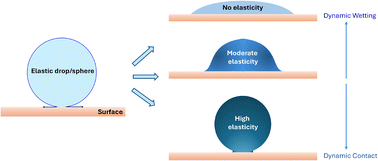
When a liquid drop makes first contact with any surface, the unbalanced surface tension force drives the contact line, causing spreading. For Newtonian or weakly elastic, non-Newtonian liquids, either liquid inertia or viscosity, or a combination of the two, resists spreading. In this work, we investigate how drop elasticity influences spreading dynamics. We conduct dynamical experiments with polyacrylamide drops of varying polymer concentrations to impart varying degrees of elasticity. Using high-speed imaging, we focus on the very first moments of spreading on glass substrates. For moderate and high Young's modulus values, we observe that the early-time spreading dynamics obey a viscous-capillary regime characterized by a power-law evolution of the spreading radius. However, the process transitions to a different regime on a timescale comparable to the characteristic viscoelastic relaxation timescale. We interpret this latter regime using a theoretical model invoking the standard linear model of viscoelasticity. For viscoelastic inks with moderate print speeds, the dynamical behavior investigated in this study can provide valuable insights into how to efficiently control such moving contact lines with non-trivial elasticity.
- This article is part of the themed collection: Materials Advances Covers
 Please wait while we load your content...


