


 PLATFORM UPDATE:


A synergistic ZnS/MWCNT heterostructure as an advanced electrode for high-performance, long-cycle life lithium-ion batteries: experimental and DFT insights

Abstract
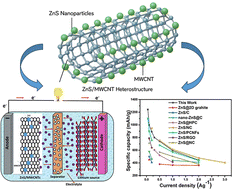
The synergistic integration of nanomaterials in heterostructures presents significant potential for the development of high-performance energy storage devices. In this work, a zinc sulfide/multi-walled carbon nanotube (ZnS/MWCNT) heterostructure is rationally designed and systematically investigated as a promising anode material for lithium-ion batteries (LIBs). Structural and microscopic analyses confirm that the heterostructure possesses a high specific surface area and enhanced electrical conductivity, making it highly suitable for efficient lithium storage. The ZnS/MWCNT anode delivers an impressive initial discharge capacity of 1960 mA h g−1 at a current density of 50 mA g−1 (vs. Li/Li+), along with a high coulombic efficiency of approximately 97.6%. Notably, it exhibits outstanding cycling stability, retaining ∼94% of its capacity after 1000 cycles. Electrochemical impedance spectroscopy (EIS) and density functional theory (DFT) analyses further reveal significantly enhanced charge transfer kinetics and lithium-ion diffusion within the heterostructure. The superior electrochemical performance is attributed to the synergistic interaction between the ZnS and MWCNTs, the robust structural integrity of the heterostructure, and its large active surface area. Moreover, the designed architecture effectively mitigates volume expansion and structural degradation during repeated charge/discharge cycles. These findings highlight the great potential of ZnS/MWCNT heterostructures as advanced anode materials for next-generation LIBs with high-rate capability and long-term cycling stability.
 Please wait while we load your content...


