


 PLATFORM UPDATE:


Moringa oleifera mediated synthesis of SrO2 and SrCO3@GO nanomaterials for energy storage applications

Abstract
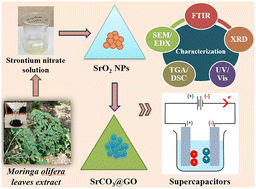
We synthesized SrO2(aq) and SrO2(et) nanoparticles (NPs) by treating strontium nitrate with aqueous and ethanolic extracts of Moringa oleifera leaves, respectively. This reaction was also performed in the presence of graphene oxide (GO) to produce SrCO3@GO(aq) and SrCO3@GO(et) nanocomposites (NCs), respectively. The nanomaterials (NMs) were characterized by X-ray diffraction (XRD), Fourier-transform infrared spectroscopy (FTIR), ultraviolet–visible spectroscopy (UV-Vis), scanning electron microscopy (SEM), energy-dispersive X-ray spectroscopy (EDX), and thermogravimetric analysis/differential scanning calorimetry (TGA/DSC). FTIR spectroscopy confirmed the characteristic Sr–O vibrations, along with additional absorption bands arising from GO and phytochemical-derived organic moieties capping the nanoparticle surfaces. The synthesized NMs exhibited crystallite sizes ranging from 2 to 45 nm, particle sizes from 34 to 271 nm, and band gaps between 4.48 and 5.63 eV. EDX analysis verified the presence of Sr, O, and C, confirming their spatial distribution. TGA–DSC analysis confirmed distinct thermal stability profiles for all materials, with SrCO3@GO(et) exhibiting the highest mass loss and enthalpy. The synthesized nanoproducts were evaluated for electrochemical performance using cyclic voltammetry (CV) and galvanostatic charge–discharge (GCD), confirming their suitability as supercapacitor electrodes. The outstanding electrochemical performance of SrCO3@GO(et) (specific capacitance, 292.59 F g−1 at 1 mA) arises from the synergistic effects of M. oleifera ethanolic extract-derived phytochemicals, effective GO decoration, reduced crystallite and particle sizes, and the development of a porous, flower-like nanostructure. Collectively, these features position SrCO3@GO(et) as a highly promising electrode material for next-generation high-performance energy storage devices.
 Please wait while we load your content...


