


 PLATFORM UPDATE:


Integrated hierarchical Z-scheme BiOCl/NiTiO3 heterostructured photoanode and its photoelectrocatalytic application in ciprofloxacin degradation
 *a
and
Nonhlangabezo
Mabuba
*ab
*a
and
Nonhlangabezo
Mabuba
*ab
Abstract
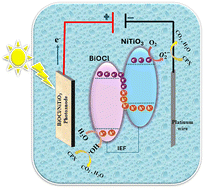
In this work, we explore the application of a BiOCl/NiTiO3 heterostructured photoanode with a remarkable synergistic advantage and unique band alignment for the photoelectrocatalytic (PEC) degradation of ciprofloxacin. Combining the excellent charge transport of BiOCl and the visible-light absorption of NiTiO3, the BiOCl/NiTiO3 photoanode facilitated electro-hole charge separation and extended light absorption owing to its distinctive band gap energy and visible-light sensitivity. These attributes were confirmed by the impressive charge-transfer advantage (Rct = 157 Ω) and band gap energy (Eg) of 2.08 eV obtained from the Nyquist and Tauc plots of the photoanode. Moreover, the BiOCl/NiTiO3 heterostructured photoanode exhibited a Z-type behaviour, evident by the flow of electrons from the conduction band of BiOCl (with a higher Fermi level) to the valence band of NiTiO3 (with a lower Fermi level). This occurrence made uncombined holes and electrons in the respective valence band of BiOCl and the conduction band of NiTiO3 readily available for the generation of reactive oxygen species in the system. The BiOCl/NiTiO3 heterostructure architecture significantly aided the photoelectrocatalytic degradation of ciprofloxacin in water, achieving a remarkable 94% degradation efficiency. In addition, the heterostructured photoanode displayed outstanding stability and reusability, making it a distinct advanced material for real-time operations. Furthermore, the findings from this work demonstrate a reliable strategy for high-performance PEC design while contributing to a sustainable approach for wastewater remediation applications.
 Please wait while we load your content...


