


 PLATFORM UPDATE:


A decoupling strategy to optimize power density in flexible thermoelectric devices using a ZIF-67 doped polypyrrole bio binder-based hybrid ink
 *a
*a
Abstract
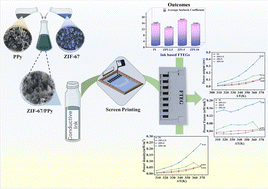
Enhancing the power density of flexible thermoelectric generators for wearable applications is always a challenge. Inclusion of porous material in the active material is one of the attractive strategies deployed to this end. Porosity of a material tunes the thermal conductivity and charge carrier mobility, resulting in enhanced power density. Zeolitic imidazolate framework-67 (ZIF-67) is widely studied for developing gas storage, separation, electrochemical energy storage, sensors, drug delivery systems, membranes, thermal insulations, and triboelectric nanogenerators due to its high thermal and chemical stability, large surface area, and tunable porosity. However, its application for thermoelectric generators has not been explored much. In this work, novel hybrid thermoelectric inks were formulated by integrating zeolitic imidazolate framework-67 (ZIF-67) into a conductive polypyrrole matrix, aiming to fabricate high-performing flexible thermoelectric generators using the screen-printing technique for low-temperature applications. The optimized 5% ZIF-67 ink-based flexible thermoelectric generator, in comparison with the pristine polypyrrole-based device, exhibits 328.6% higher power density. Additionally, a 5% ZIF-67-MnO2 based p–n type FTEG exhibited a Seebeck coefficient of 171.6 µV K−1 and a power output of 26 nW. These results demonstrate the potential of ZIF-67-polypyrrole hybrid inks for eco-friendly, flexible energy harvesting applications.
 Please wait while we load your content...


