


 PLATFORM UPDATE:


Exploring facet-engineered anatase nanoparticles for amplification of sensitivity in heavy metal ion detection and other applications
 *a
and
Md.
Sahadat Hossain
*a
*a
and
Md.
Sahadat Hossain
*a
Abstract
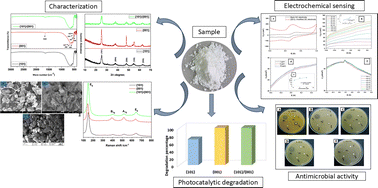
TiO2 is one of the most extensively studied nanomaterials due to its remarkable surface, catalytic, and electronic properties, which are further enhanced when synthesized with exposed facets. In this study, anatase-phase TiO2 nanoparticles with different crystal facets were synthesized using inorganic modifiers through a hydrothermal method. The synthesized samples were characterized using various analytical techniques. X-ray diffraction (XRD), Fourier transform infrared spectroscopy (FTIR), and Raman spectroscopy confirmed the formation of anatase TiO2. The crystallite size, estimated from XRD data, ranged between 1–50 nm, except for the linear straight-line method (LSLM), which exhibited a higher value. Growth preference, texture coefficient and Raman data and structural analysis verified the facet formation. Additionally, thermogravimetric analysis (TGA) revealed enhanced thermal stability of the samples. Photocatalytic studies demonstrated that {001}-faceted and {101}/{001} co-faceted TiO2 achieved complete degradation of Congo Red (CR) dye within 30 min, significantly outperforming {101}-faceted TiO2 (69.36% degradation). Scavenging experiments confirmed that ˙OH radicals played the dominant role in CR degradation over the {001}-faceted TiO2. Kinetic studies based on the Langmuir–Hinshelwood model revealed apparent rate constants of 0.0202 min−1 for {101}-faceted TiO2, 0.0081 min−1 for {001}-faceted TiO2, and 0.0127 min−1 for {101}/{001}-co-faceted TiO2. Furthermore, {001}-faceted TiO2 exhibited significant antimicrobial efficacy against Gram-positive bacteria, attributed to enhanced surface activity. Electrochemical studies revealed the superior sensing capabilities of {001}-faceted TiO2 for Pb2+ ion detection, with its enhanced electroactive surface area contributing to a limit of detection (LOD) of 9.378 ppm and a limit of quantification (LOQ) of 31.162 ppm.
 Please wait while we load your content...


