


 PLATFORM UPDATE:


The role of aluminum in controlling defect formation and polytypism in silicon carbide via thermal synthesis

Abstract
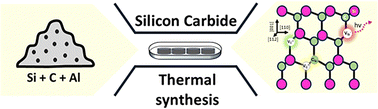
The synthesis of silicon carbide has been widely explored to tailor its material properties for specific needs, particularly particle size, polytype distribution, and defect density. While many applications require defect-free material, the intrinsic defect states in SiC make it an attractive candidate for quantum technologies. However, the controlled introduction of such defects remains a major challenge. In this work, we investigate the influence of aluminium concentration and high-energy ball milling duration on defect formation and polytype distribution in silicon carbide synthesized through controlled thermal reactions. Our findings highlight the critical role of Al in altering the reaction between Si and C, stabilizing specific polytypes, and promoting the formation of optically and magnetically active point defects. Multivariate analysis using machine learning-assisted partial least squares regression revealed strong correlations between structural parameters and defect concentrations. These results demonstrate that optimizing Al concentration and milling conditions enables controlled synthesis of SiC with tailored polytypism and targeted defect configurations, presenting a scalable route for quantum technological applications.
- This article is part of the themed collection: Materials Advances Covers
 Please wait while we load your content...


