


 PLATFORM UPDATE:

Enhanced adsorption of methylene blue (MB) dye by the MoS2/ZIF-8 composite: isotherm and kinetics studies

Abstract
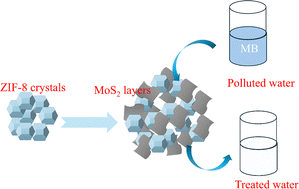
In this study, a zeolitic imidazolate framework (ZIF-8) loaded with molybdenum disulfide (MoS2) was prepared via a hydrothermal method. The as-prepared MoS2/ZIF-8 composite displayed a mesoporous structure with a BET surface area of 19.13 m2 g−1 and a mean pore diameter of 9.33 nm. The as-prepared ZIF-8 and MoS2/ZIF-8 composite were utilized as adsorbents for cationic dye from aqueous solution, and methylene blue (MB) dye was used as a pollutant model. The effects of pH, contact time, initial dye concentrations, adsorbent doses, and temperature on the adsorption efficiency were investigated. The adsorption study confirmed that the MoS2/ZIF-8 composite displayed higher adsorption capacity toward MB dye than that achieved with pristine ZIF-8. Moreover, the adsorption of MB dye onto ZIF-8 and the MoS2/ZIF-8 composite is an endothermic process. The adsorption kinetics confirmed that the adsorption of MB onto ZIF-8 and the MoS2/ZIF-8 composite fit the pseudo-second-order models, and the adsorption isotherm agreed with the Langmuir isotherm models, which confirms the chemical adsorption process. The estimated maximum adsorption capacities of ZIF-8 and the MoS2/ZIF-8 composite were 68.02 and 85.52 mg g−1, respectively. Thermodynamic analysis determined the process to be spontaneous, endothermic, and followed by enhancement of disorder at the solid–liquid interface. Mechanistic interpretations suggest MB adsorption to be mediated by electrostatic attraction, chemisorption at active sites, and physisorption via van der Waals forces. The MoS2/ZIF-8 composite is thus a highly effective and recyclable adsorbent for desorption of cationic dye from wastewater.
 Please wait while we load your content...


