


 PLATFORM UPDATE:


Oxidation behavior of iron and binder-mixed iron: insights from TGA–DSC and in situ XRD analysis for field emission application
 *ab
S.
Premkumar,
ac
Mahendra A.
More,
a
Damien
Thiry,
d
Nathalie
De Geyter,
b
Vikas L.
Mathe
*a
and
*ab
S.
Premkumar,
ac
Mahendra A.
More,
a
Damien
Thiry,
d
Nathalie
De Geyter,
b
Vikas L.
Mathe
*a
and
Abstract
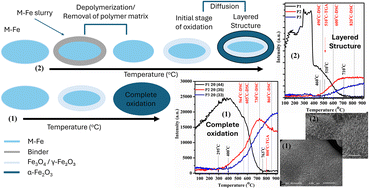
Precise control over the phase composition and surface morphology of materials is crucial for applications in catalysis, sensing, field-emission, and other fields. This study investigates the thermal oxidation of micron-sized iron (M–Fe) both with and without the use of ethyl cellulose as a binder in various oxidation environments. The samples were processed in starving and oxygen-rich conditions with varying heating rates to investigate their impact on oxide formation. A custom-designed radiation heater (RH) was employed in the vacuum system to achieve an ultra-fast heating rate of 12 °C s−1, raising the surface temperature to 750 °C within one minute. Oxidation experiments under reduced oxygen pressure, termed controlled environment thermal oxidation (CETO), were compared to open environment thermal oxidation (OETO), conducted at the same target temperature but with a significantly slower heating rate (2.5 °C min−1) in a muffle furnace. The role of the binder was analyzed using thermogravimetric analysis and differential scanning calorimetry (TGA–DSC), and a deeper understanding was gained through a phase evolution study, as elucidated by in situ X-ray diffraction (XRD) measurements. The phase evolution of iron, both with and without binder, in two distinct surrounding conditions, primarily affects the onset temperature. The findings highlight the critical influence of oxidation conditions, heating rate, and the presence of binder on the surface properties, paving the way for improved design strategies in field emission applications.
- This article is part of the themed collection: Materials Advances Covers
 Please wait while we load your content...


