


 PLATFORM UPDATE:

A planar T-carbon structure with tunable electric and optical properties via chemical decorations on the (111) plane: a first-principles investigation
 *d
*d
Abstract
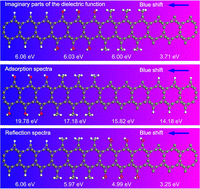
We proposed a novel two-dimensional carbon allotrope designated as 2-(111) planar T-carbon, obtained by slicing bulk T-carbon along its (111) crystallographic direction. This orientation selection is rationalized by two critical factors: the (111) surface exhibits the most intense diffraction signature in experimental characterization and demonstrates the lowest surface energy among potential cleavage planes. Through systematic first-principles investigations, we demonstrate that surface chemical decoration serves as an effective strategy to simultaneously engineer the optoelectronic characteristics and enhance the thermal/dynamic stability of 2-(111) planar T-carbon. Comparative analysis of DFT-calculated phonon spectra between pristine and three decorated configurations confirms that surface functionalization provides a promising and feasible pathway to achieve structural stabilization. First-principles calculations reveal a tunable direct bandgap ranging from 0.81 eV (–OH decorated) to 2.81 eV (hydrogenated), with chemical modifications inducing predictable blue shifts in optical spectra. Furthermore, the simultaneous application of multiple chemical decorations enables progressive tuning of optoelectronic properties, establishing a gradient modulation platform for performance optimization.
 Please wait while we load your content...


