


 PLATFORM UPDATE:


High-performance hollow microspheres for UV protection from cinnamate-functionalized cellulose nanocrystals and inorganic nanoparticles
 a
To
Ngai
*a
a
To
Ngai
*a
Abstract
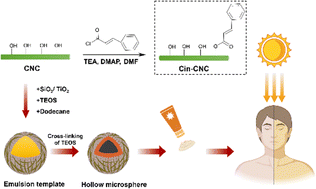
To mitigate the harmful effects of UV radiation, sunscreens are indispensable in sun protection strategies. Sunscreen agents are broadly categorized into two types: inorganic and organic UV filters. Current organic UV filters raise health concerns due to poor photostability and harmful radical generation, while inorganic UV filters often leave white residues on the skin. To address these limitations, we develop a novel method for synthesizing hollow microspheres using cinnamate-functionalized cellulose nanocrystals (Cin-CNCs) and inorganic nanoparticles (SiO2 or TiO2) via Pickering emulsion templating to enhance sunscreen performance. The stabilization mechanism involves synergistic interactions between the hydrolysis products of tetraethyl orthosilicate (TEOS), Cin-CNCs, and SiO2 nanoparticles. The resulting cinnamate-functionalized hollow microspheres exhibit excellent water dispersibility and superior photostability compared to traditional organic UV filters. Unlike conventional inorganic UV filters, they display significantly improved transparency in the visible range and enhanced UV shielding properties, owing to the grafting of cinnamate groups and their unique hollow structure. Both Cin-CNCs/SiO2 and Cin-CNCs/TiO2 hollow microspheres demonstrate superior UV protection capabilities compared to their nanoparticles counterparts. When formulated into sunscreens, they achieve higher SPF values than conventional inorganic UV filters. These findings highlight the potential of cinnamate-functionalized hollow microspheres as a next-generation UV-blocking agent in sunscreen formulations.
 Please wait while we load your content...


