


 PLATFORM UPDATE:


Tailored imprinted polymers for selective recognition of sulfonated dyes: extraction of dyes from soft drinks, water and food samples

Abstract
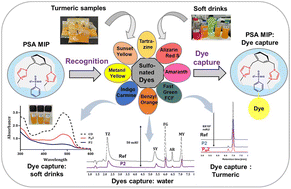
Synthetic sulfonated food dyes in beverages and processed foods pose health and environmental risks due to their persistence and potential toxicity. Traditional detection methods for these dyes lack selectivity and involve excessive solvent use. Herein, we report the synthesis of molecularly imprinted polymers (MIPs) featuring high affinity and enhanced capacity for binding to sulfonated dyes. The MIPs were prepared using phenyl sulfonic acid (PSA) as a template, a tweezer-type bis-imidazolium functional monomer, 2-hydroxyethyl methacrylate (HEMA) co-monomer, and ethylene glycol dimethacrylate (EGDMA) crosslinker. The recognition performance of the PSA-imprinted MIPs was evaluated via rebinding isotherm data, fitted to the mono-Langmuir isotherm model, which revealed binding capacities ranging from 100–300 µmol g−1 with 103–104 M−1 affinity in organic and aqueous solvents. The optimized MIPs demonstrated superior affinity for a wide range of structurally diverse sulfonated dyes containing a PSA substructure. Their practical applicability was confirmed through successful recognition of commercial dyes in water, soft drinks, and food matrices, including the successful capture of food dye from adulterated turmeric samples. As a proof-of-concept, class-selective MIPs were employed as adsorbents in solid-phase extraction (SPE) cartridges, effectively capturing trace amounts of sulfonated dyes from water. Collectively, these results underscore the potential of the developed MIPs for food monitoring and environmental remediation.
 Please wait while we load your content...


