


 PLATFORM UPDATE:


Polymersomes with aggregation-induced emission: synthesis, self-assembly, and biomedical applications
 *a
*a
Abstract
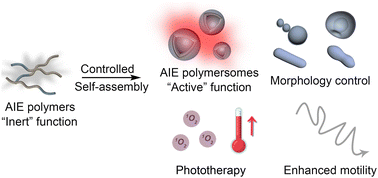
Polymeric vesicles, also known as polymersomes, are self-assembled nanostructures typically from amphiphilic block copolymers. They have been regarded as versatile platforms with broad biomedical applications owing to their facile ability to modulate their chemical structure, tunable membrane properties, and high cargo-loading capacity. The integration of aggregation-induced emission (AIE) luminogens into polymersomes has emerged as a powerful strategy to overcome the disadvantageous effects of conventional fluorophores, such as aggregation-induced quenching and photobleaching. This enables AIE-active polymersomes to exhibit bright fluorescence, enhanced photostability, and multifunctionality in complex biological environments. In this review, we discuss recent advances in AIE-active polymersomes, with an emphasis on their molecular design, self-assembly behaviors, and biomedical applications. We highlight how precise control over polymer composition, block architecture, and AIEgen incorporation governs vesicle formation, size, morphology, membrane properties, and function. The emerging biomedical applications of AIE-active polymersomes are then summarized, including bioimaging, catalysis, drug delivery, photodynamic therapy, and theranostics, highlighting the synergistic integration of imaging and therapeutic functions. Finally, current challenges and future perspectives are discussed, particularly regarding biodegradability and stimulus responsiveness of next-generation AIE-active polymersomes for advanced biomedical applications and clinical translation.
- This article is part of the themed collection: RSC Applied Polymers Emerging Investigators 2025
 Please wait while we load your content...


