


 PLATFORM UPDATE:


Mechanical and interfacial properties of zwitterionic hydrogels via a high-entanglement network design: a study of monomer and crosslinker synergy

Abstract
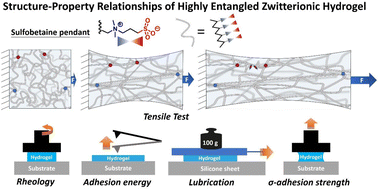
Hydrogels with high water content and biocompatibility are attractive for biomedical applications, but generally suffer from poor mechanical strength and limited durability. Recently, the high-entanglement network strategy has emerged as a simple yet powerful approach to enhance hydrogel mechanics by forming densely entangled polymer chains with minimal crosslinking density. In this study, we extend this concept to zwitterionic hydrogels to achieve mechanical resilience, superior adhesion, lubricity and antifouling properties. Four sulfobetaine-based monomers, sulfobetaine acrylamide (SBAA), sulfobetaine methacrylamide (SBMAA), sulfobetaine acrylate (SBA) and sulfobetaine methacrylate (SBMA), were polymerized under highly concentrated conditions with crosslinked structures using N,N′-methylenebisacrylamide (MBAA) or N,N′-methylenebismethacrylamide (MBMA). Systematic comparison revealed that the monomer structure, hydrogen-bonding capacity, and α-methyl substitution critically influence the polymerization kinetics, network homogeneity, mechanical properties, viscoelasticity, frictional and antifouling behaviors. The resulting zwitterionic hydrogels developed by suitably pairing the monomer and crosslinker exhibited enhanced elasticity, toughness, ultralow friction, good adhesion and antifouling properties under physiological conditions. These findings establish high entanglement as an effective structural design principle for developing mechanically resilient and antifouling hydrogels for biomedical devices and soft material interfaces.
 Please wait while we load your content...


