


 PLATFORM UPDATE:


3D UV printing with a polymeric ionic liquid and its gold nanoparticle-embedded composites
 *a
*a
Abstract
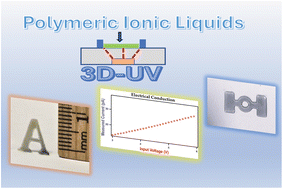
Polymeric ionic liquids are a diverse class of ion-conducting materials with tunable properties that can advance the applicability of additive manufacturing. However, the potential of 3D UV printing of polymeric ionic liquids with metallic fillers for electronic applications remains somewhat limited. In this work, we formulated photocurable resins using a methacrylate-based ionic liquid monomer and a crosslinker, with and without gold nanoparticles as fillers. Our results show that centimeter-scale structures, both free-standing and bonded to a substrate, can be prepared straightforwardly from the formulations using commercial 3D UV printers. The printed structures exhibited high fidelity, a high degree of polymerization, and high thermal stability, with stiffness ranging from 0.2 GPa to 0.5 GPa. Increasing the content of gold nanoparticles in the ionic liquid composites increased the glass transition temperature from −23 °C to −3.5 °C. Polymers without gold nanoparticles had a conductivity of 10−6 S cm−1, which increased to 10−4 S cm−1 in prints with 1 wt% of gold nanoparticles. 3D-printed resistors made from 1 wt% of gold nanoparticles maintained a stable current profile for several hours. Such a result highlights the potential to prepare ionic-liquid-based flexible electronic components using commercial 3D UV printers.
 Please wait while we load your content...


