


 PLATFORM UPDATE:


Design of tuneable, biocompatible anionic polymers by l-norvaline amino acid post-polymerisation modification of pentafluorophenyl acrylate copolymers
 ab
Michael
Streiber,
ab
Christopher
Kuenneth,
d
Ulrich S.
Schubert,
abef
Anja
Traeger
*ab
and
Meike N.
Leiske
*cg
ab
Michael
Streiber,
ab
Christopher
Kuenneth,
d
Ulrich S.
Schubert,
abef
Anja
Traeger
*ab
and
Meike N.
Leiske
*cg
Abstract
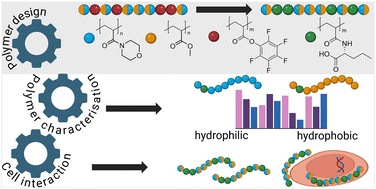
Based on their high cytocompatibility and unique interactions with biological matter, polyanions are attracting increasing research interest. The hydrophilicity–hydrophobicity ratio of these substances exerts a significant influence on their applicability as delivery systems, i.e., for particle formation and their interaction with biological matter. In this study a library of anionic copolymers with tailored hydrophilicity–hydrophobicity ratio is generated: First, random copolymers of pentafluorophenyl acrylate (PFPA) and hydrophilic N-acryloylmorpholine (NAM) or hydrophobic methyl acrylate (MA), respectively, are synthesised. In a second step, the PFPA units are substituted by L-norvaline (Nva) via post-polymerisation modification. We found that the comonomer ratio within the polymer has an impact on the hydrophobicity of the copolymers – in particular the Nva moiety significantly influences the hydrophobicity. Moreover, all investigated polymers feature good biocompatibility, while an increase in NAM content only slightly affects the hemolytic activity. Furthermore, an exemplary tested NAM-copolymer shows fast intracellular uptake in just 4 h. Our results obtained with Nva modified copolymers of different hydrophobicity-hydrophilicity ratio indicate that those polyanions could have potential for further biomedical applications such as drug delivery.
- This article is part of the themed collections: RSC Applied Polymers Advisory Board and RSC Applied Polymers Emerging Investigators 2025
 Please wait while we load your content...


