


High-refractive-index copolymers produced by radical copolymerization of aromatic heterocyclic monomers in deep eutectic solvents
 b
and
Hideharu
Mori
*a
b
and
Hideharu
Mori
*a
Abstract
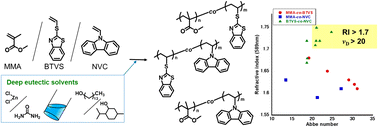
The development of a greener and more efficient methodology for simultaneously achieving polymers with a high refractive index, high Abbe number, good transparency, and high thermal stability remains a challenge, particularly for sustainable production using environmentally friendly solvents. Herein, we report the green production of high-refractive-index copolymers in a deep eutectic solvent (DES) by the radical copolymerization of aromatic heterocyclic S-vinyl and N-vinyl monomers, namely benzothiazoyl vinyl sulfide (BTVS) and N-vinyl carbazole (NVC), combined with methyl methacrylate (MMA). Three hydrophobic natural DESs (NADESs; Thy/Cou, Thy/Men, and Tdc/Men) prepared from naturally derived compounds (Thy: thymol, Men: (±)-menthol, Cou: coumarin, and Tdc: 1-tetradecanol) and two hydrophilic DESs prepared from choline chloride (ChCl) and zinc chloride (ZnCl2) with urea (ChCl/urea and ZnCl2/urea) were used for the radical copolymerization of MMA/BTVS, MMA/NVC, and BTVS/NVC. An increase in both the polymer yield and molecular weight of the resulting copolymers was observed, depending on the nature of the DESs and the polymerization conditions. P(BTVS-co-NVC)s prepared at a constant feed ratio (100/100) in the DESs exhibited high refractive indices (1.6738–1.7359 at 589 nm), which were higher than those of P(MMA-co-BTVS)s (1.6076–1.6794) and P(MMA-co-NVC)s (1.5922–1.6349). Three series of the copolymers showed good transparency (>96% at 400 nm) and high thermal stability (Td5 = 378 °C, 249 °C, and 246 °C for MMA/NVC, MMA/BTVS, and BTVS/NVC copolymers, respectively). P(BTVS-co-NVC) prepared at a suitable BTVS/NVC (150/50) feed ratio in ZnCl2/urea showed the highest refractive index (1.7528) with a relatively high Abbe number (21.1), which differs from the general tendency for a trade-off between refractive index and Abbe number. This work demonstrates the great potential of DESs for the sustainable production of next-generation high-refractive-index polymers and provides new opportunities for their applications in related fields.
- This article is part of the themed collection: Sustainable Development Goal 3: Good Health and Well-Being
 Please wait while we load your content...


