


 PLATFORM UPDATE:


Model-based optimization of properties of post-consumer recycled PP/PE blends via compatibilization

Abstract
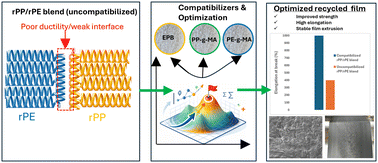
The reuse of post-consumer recycled polypropylene (rPP) is limited by poor processability, immiscibility with polyethylene (PE), and reduced mechanical properties. This work applies compatibilization strategies and regression-based optimization to improve the performance of a monolayer cast-film of a commercial recyclate containing ∼55 wt% PP and ∼45 wt% HDPE. Three compatibilizers were examined: maleic anhydride-grafted-polyethylene (PEMA), maleic anhydride-grafted-polypropylene (PPMA), and an ethylene–propylene copolymer (EPB). Tensile testing in the machine (MD) and transverse (TD) directions, FTIR, and SEM were combined with multiple regression to guide blend formulation. PEMA and PPMA exhibited quadratic effects on yield stress with optima near 8–11 wt%, whereas EPB showed a positive linear effect on modulus. At practical loadings, model coefficients correspond to gains of ∼6.1 MPa and ∼4.2 MPa in yield stress for 10 wt% PEMA and PPMA respectively, and ∼+5 MPa and +170 MPa in yield stress and modulus respectively for 20 wt% EPB. Two model-guided blends: (i) single-objective optimization (based on PEMA/EPB) and (ii) multiple objective optimization (based on PEMA/PPMA/EPB), produced smoother films and improved stiffness–ductility balance relative to the uncompatibilized recyclate. Single-objective optimization improved elongation by 3776% (MD) and 1371% (TD), with strength gains of up to 448%. Multiple-objective optimization incorporating 2% PPMA achieved the best balance, combining 1686% higher elongation (TD) with 491% higher yield stress and 240% higher stiffness SEM indicated reduced voiding and more cohesive fracture surfaces; FTIR remained consistent with physical interfacial anchoring/bridging rather than new covalent bonding. These results highlight a materials design pathway to enable reliable, high-performance use of recycled PP/PE blends in film and packaging applications.
 Please wait while we load your content...


