


 PLATFORM UPDATE:


Poly(ethyl glyoxylate)-derived self-immolative elastomers

Abstract
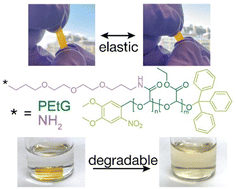
The development of degradable elastic materials has become important to reduce waste and develop transient devices. Most degradable elastomers have issues with uncontrolled and random degradation and poor storage stability. Self-immolative polymers (SIPs) can offer stabilization and triggered depolymerization through stimuli-responsive end-caps. In this paper, we describe the crosslinking of poly(ethyl glyoxylate) (PEtG), a SIP with UV and acid labile end-caps, to create an elastic polymer network. The material withstood strains up to 100 percent before failure in our pull to break tests and was able to withstand up to 10 repeated strains of 20 percent with little change to the stress strain curve. The material was then exposed to degradation conditions where UV light triggered partial degradation and 1 molar hydrochloric acid degraded it fully. The controlled degradability and mechanical properties of this material represent a step towards sustainable transient devices.
- This article is part of the themed collections: RSC Applied Polymers Advisory Board and RSC Applied Polymers Emerging Investigators 2025
 Please wait while we load your content...


