


 PLATFORM UPDATE:


The effect of Bisphenol A vs. Bisphenol F on the performance of polysulfone membranes
 ab
Matthew D.
Green
*ab
ab
Matthew D.
Green
*ab
Abstract
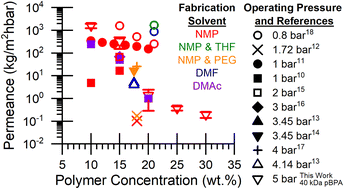
Microfiltration is widely used in water filtration to remove large particles, suspended solids, and bacteria. This study examines polysulfone membranes fabricated via nonsolvent-induced phase separation (NIPS) using Bisphenol A (pBPA) and Bisphenol F (pBPF) at 20 and 40 kDa molecular weights. The relationship between water permeance and the viscosity of polymer solutions used for membrane fabrication is explored through solution rheology and permeability tests. Thermal properties, analyzed by thermogravimetric analysis (TGA) and differential scanning calorimetry (DSC), confirmed high stability for both polymers, with degradation temperatures above 450 °C and glass transition temperatures between 160–190 °C; pBPF undergoes a two-step degradation process. The Young's modulus increases with molecular weight and polymer casting solution concentration, as indicated by stress–strain curves, with similar trends in strength across membranes cast at similar concentrations. Deionized (DI) water permeance decreases logarithmically with membrane thickness, polymer concentration in the membrane solution, and viscosity. Across all polymers at equivalent casting concentrations, comparable DI water permeance is observed. Organic solvent permeation studies (ethanol, 1-butanol, ethylene glycol, and 1,4-butanediol) revealed viscosity was the dominant factor controlling transport. The sharp decrease in the distance between Hansen's solubility parameters (Ra) from water (∼44) to organic solvents (16–23) predicted the onset of substantial swelling, though the narrow range among organic solvents produced minimal variation in swelling. These findings provided insights into the various ways processing conditions can influence the properties and potential utility of polysulfone membranes for microfiltration processes.
 Please wait while we load your content...


