


 PLATFORM UPDATE:


Effects of polyether polyol hydroxyl equivalent weight on controlled release polyurethane coatings of urea (46-0-0)

Abstract
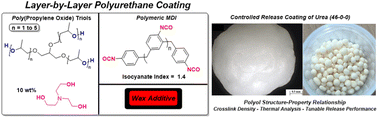
Layer-by-layer polyurethane coatings incorporating wax additives were applied to urea granules (46-0-0) to investigate the influence of poly(propylene oxide) triol molecular weight on controlled-release fertilizer (CRF) performance. Triols ranging from 260–1000 g mol−1 were evaluated at constant coating weight, triethanolamine active catalyst inclusion, temperature, and isocyanate index to modulate hydroxyl equivalent weight (HEW), calculated crosslink density, and measured glass transition temperature (Tg) for the coating formulations. Castor oil-derived polyurethane served as a benchmark to validate the chosen coating process variables. Lower-HEW triols required increased polyisocyanate content to maintain stoichiometry, resulting in higher crosslink densities and enhanced nutrient release control. In contrast, the glycerol-based coating, despite a high calculated crosslink density and measured Tg failed to form uniform films, leading to negligible release. These results establish a structure–property relationship linking poly(propylene oxide) triol molecular weight to CRF performance, enabling tunable release profiles through precise polyurethane formulation.
- This article is part of the themed collection: Young Investigator Honorees of the ACS Polymeric Materials: Science and Engineering (PMSE) Division.
 Please wait while we load your content...


