


 PLATFORM UPDATE:


Polydimethylsiloxane gel thickness and stiffness affect the initial adhesion of Escherichia coli and Staphylococcus aureus
 a
Meng-Chen
Chiang,
a
Dylan
Lechner,
a
Uzochi
Uwazuruonye-Anyanwu
a
and
Jessica D.
Schiffman
*ab
a
Meng-Chen
Chiang,
a
Dylan
Lechner,
a
Uzochi
Uwazuruonye-Anyanwu
a
and
Jessica D.
Schiffman
*ab
Abstract
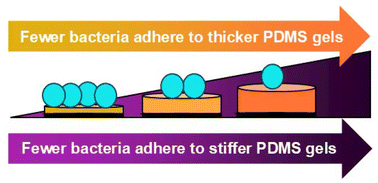
The persistent presence of hospital-acquired bacterial infections and the growing prevalence of antibiotic-resistant bacterial strains necessitates a greater understanding of the initial adhesion of bacteria to biomaterials. While the mechanical properties of polydimethylsiloxane (PDMS) gels have been shown to influence the initial attachment of microorganisms, to date, attachment has only been assessed on gels that are 1000× larger than the microorganisms evaluated. Here, a library of nine PDMS gels were manufactured to be thin (∼10 µm), medium (∼35 µm) and thick (∼100 µm) with distinct Young's Moduli that were considered to be soft (E = ∼60 kPa), standard (E = ∼1150 kPa), and stiff (E = ∼1700 kPa). All gels were well characterized using atomic force microscopy. Next, the initial adhesion of microorganisms to the gels was assayed using two strains of Escherichia coli (K12 MG1655 and CFT073), as well as two strains of Staphylococcus aureus (SH1000 and methicillin-resistant S. aureus, i.e., MRSA), representing both well-studied and clinically relevant microorganisms. Bacterial adhesion was the greatest on the thinnest, softest PDMS gels, with S. aureus SH1000 demonstrating the greatest changes in adhesive behavior in response to gel thinness. These findings suggest that both PDMS gel stiffness and thickness are important factors when considering the initial adhesion of these Gram-negative and Gram-positive microorganisms to hydrophobic biomaterials.
- This article is part of the themed collection: Sustainable Development Goal 6: Clean Water and Sanitation
 Please wait while we load your content...


