


 PLATFORM UPDATE:


Controlled in situ acidification enables the 3D printability of GelMA–dextran aqueous two-phase hydrogel with unique interconnected porosity

Abstract
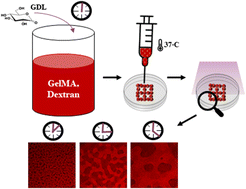
Hydrogels with tailored porosity and microstructure are essential for biomedical applications such as drug delivery and tissue engineering, yet precise control over their internal architecture remains a challenge. A promising strategy relies on bicontinuous systems formed via spinodal decomposition of polymer blends, enabling the design of hydrogels with tunable and interconnected porosity. By selectively using one polymer as a sacrificial template, hydrogels with large interconnected pores can be developed, enhancing cell growth and migration, nutrient transport, and cellular waste removal. However, the inherent instability of bicontinuous systems, makes it difficult to arrest the microstructure at a defined stage, limiting reproducibility and precise control over pore architecture. Herein we report a straightforward strategy to regulate the phase separation process of GelMA–dextran aqueous two-phase systems (ATPS), enabling 3D printing of hydrogels with tunable porous microarchitectures. By introducing glucono delta-lactone (GDL) into the ATPS, a gradual decrease in pH is achieved, which delays and slows down the kinetics of phase separation. UV photocrosslinking at a selected time point arrests the evolving bicontinuous structure, offering precise control over the pore size and morphology. The results confirm fine-tuning of the phase separation dynamics and enhanced reproducibility. Notably, the GDL-mediated pH control stabilizes the mixture long enough to allow 3D printing, without interfering with the phase separation or the final microstructure. The printed hydrogels retain their interconnected morphology, with tunable channel sizes depending on the timing of crosslinking. This approach offers a robust and versatile route to structure hydrogels with controlled porosity and architecture. It opens new opportunities for the design of biofunctional materials with improved mass transport and mechanical properties, tailored to specific biomedical applications, and it is compatible with advanced fabrication methods like 3D printing.
 Please wait while we load your content...


