


 PLATFORM UPDATE:


Understanding nucleation efficiency of stereocomplex-crystallites on homochiral crystallization in poly(l-lactide)/poly(d-lactide) blends: homogenization near crystal growth front

Abstract
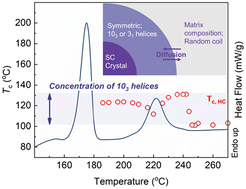
Understanding the concurrent behavior of homochiral (HC) and stereocomplex (SC) crystallization in stereocomplex polylactide (SCPLA) is crucial for developing polymorphic SCPLA-based materials for a range of applications. This work explores the SC-nucleated HC crystallization behavior in symmetric, poly(ethylene glycol)-plasticized, and asymmetric SCPLA systems under both non-isothermal and isothermal conditions. Pre-existing SC crystals with different states were generated by annealing samples at various temperatures, and their influence was assessed through nucleation efficiency (NE), Avrami exponents, and the crystallization half-time of SC-nucleated HC crystallization. Variations in the results can be attributed to differences in the concentration of 103 helices in local regions near the crystal growth front following SC crystallization. This work suggests that a dynamic equilibrium between thermal fluctuation, composition gradient-driven homogenization, and nucleation-driven aggregation processes control the concentration of these helices. Aggregation enriches local regions with 103 and 31 helices, promoting both HC and SC nucleation while restricting random-coil diffusion, whereas homogenization disperses these ordered segments into the surrounding matrix, diminishing their local influence. This mechanistic perspective offers new insight into the interplay between helical accumulation and matrix relaxation in SC-nucleated HC crystallization and provides guidance for the design of next-generation polymorphic SCPLA-based materials.
 Please wait while we load your content...


