


 PLATFORM UPDATE:


Functionalized nano SiO2 reinforced gelatin–PVA hydrogels for sustainable wood adhesion

Abstract
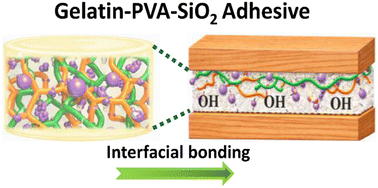
The development of sustainable wood adhesives that avoid formaldehyde-based chemistries remains an important challenge for the wood composite industry. In this work, bio-based adhesive hydrogels based on gelatin and poly(vinyl alcohol) (PVA) were reinforced with surface-functionalized silica nanoparticles to enhance their rheological and adhesive performance. Silica nanoparticles were synthesized via a modified Stöber sol–gel process and functionalized with 3-aminopropyltriethoxysilane (APTES) to introduce surface amine groups capable of interacting with the polymer matrix. The nanoparticles were incorporated into gelatin/PVA blends with different polymer ratios (2 : 1–5 : 1 gelatin : PVA), and the resulting hybrid systems were characterized using SEM, DLS, FTIR, TGA, and rheological analysis. The incorporation of SiO2-APTES significantly reinforced the hydrogel network, increasing storage modulus and viscosity while maintaining pronounced shear-thinning behaviour suitable for adhesive applications. The strongest improvement was observed for the 5 : 1 gelatin : PVA formulation, where nanoparticle incorporation increased the storage modulus from ∼240 to ∼450 Pa. Lap-shear testing on wood substrates revealed a maximum adhesion strength of 735 ± 25 kPa, corresponding to a 71% increase compared with the unfilled gelatin/PVA adhesive and a 122% increase relative to gelatin alone. These improvements are attributed to a combination of proposed interactions, including hydrogen bonding, ionic interactions, and possible mechanical interlocking between the functionalized nanoparticles, polymer network, and wood surface. The results demonstrate that silica-reinforced gelatin/PVA hydrogels represent a promising formaldehyde-free, bio-based adhesive platform for sustainable wood bonding applications.
 Please wait while we load your content...


