


 PLATFORM UPDATE:


Benzoate-mediated generation of front–back reversible photoluminescence in transparent polymer/LDH:Tb,Eu nanocomposite films
 a
and
Shinobu
Fujihara
*a
a
and
Shinobu
Fujihara
*a
Abstract
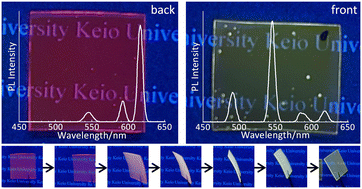
Transparent and luminescent organic/inorganic nanocomposite films were fabricated through aqueous solution routes. Water-soluble poly(vinyl alcohol) (PVA) was employed as an organic matrix, while hydrophilic layered double hydroxides (ZnAl-LDH) activated with rare-earth (RE) ions (Tb3+ or Eu3+) were synthesized as flake-like nanoparticles to be used as inorganic luminescent components. Photoluminescence (PL) intensity could be increased by exchanging nitrate ions, which originated from raw materials and were initially included in ZnAl-LDH, for ultraviolet (UV)-absorbing benzoate ions through efficient energy transfer known as the antenna effect. A large difference in the wavelength-dependent absorbance of the benzoate ions was imprinted in the PL excitation spectra of our transparent films, opening an opportunity for controlling PL intensity based on the Lambert–Beer law. Such a PL mechanism was applied to multi-layer PVA/LDH:Tb,Eu nanocomposite films having unique emission properties including mixed-color emissions upon excitation at one wavelength, continuously and reversibly color-tunable emissions upon moving slowly, and distinctly color-switching emissions upon flipping over. Our results will be useful for designing and developing easily formable and highly flexible optical components necessary for directional UV imaging, security printing, fluorescence sensing, and so on.
 Please wait while we load your content...


