


 PLATFORM UPDATE:


Electrocatalytic characteristics of Cu0.95Co2.05O4/MoO3/NF with a heterojunction for pyrazine hydrogenation

Abstract
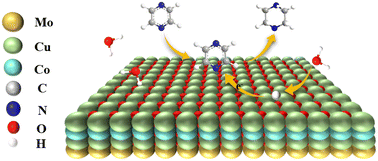
Electrocatalytic hydrogenation of N-heterocyclic compounds using water as the hydrogen source under mild conditions offers a promising route for liquid organic hydrogen carrier (LOHC) storage, yet achieving both high activity and selectivity with non-precious metal catalysts remains challenging. In this study, we developed a self-supported Cu0.95Co2.05O4/MoO3/NF heterojunction electrocatalyst that enables efficient pyrazine hydrogenation to piperazine. The heterointerface creates a strong built-in electric field, which drives directional electron transfer from MoO3 to Cu0.95Co2.05O4. This electronic redistribution renders Cu sites that are electron-rich for selective pyrazine adsorption/hydrogenation, whereas Mo and Co sites become electron-deficient to promote water dissociation and active hydrogen (H*) generation. The spatially adjacent sites work synergistically via a surface spillover mechanism, suppressing the competing hydrogen evolution reaction. As a result, the catalyst delivers a pyrazine conversion >95% and a piperazine selectivity >80% after 1.5 h at −0.25 V vs. RHE in alkaline medium, with excellent cycling stability. This work demonstrates that interfacial electronic engineering of non-noble metal heterostructures provides a viable strategy for mild, low-cost LOHC hydrogenation.
 Please wait while we load your content...


