


 PLATFORM UPDATE:


Important but often overlooked issues in heterojunction photocatalysts

Abstract
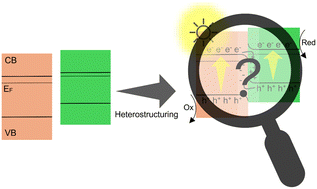
When appropriately constructed, heterojunctions in photocatalysts can significantly enhance light absorption, charge separation, surface reaction yields, and photostability, thereby improving overall performance. However, the mechanisms behind the improved performance are often misassigned due to incomplete physicochemical characterization, reliance on indirect evidence, and the widespread use of oversimplified band structure models. This Perspective highlights common diagnostic pitfalls and emphasizes that the actual interfacial energetics after semiconductor contact determine the true charge-transfer pathways. We outline a practical, multi-technique approach combining surface potential mapping, photoexcited carrier dynamics, radical identification, and operando measurements to reliably distinguish heterojunction configurations. We further discuss key considerations for material selection. These guidelines aim to support the mechanism-driven design of heterojunction photocatalysts for improved performance.
 Please wait while we load your content...


